Recruiting AI is regulated in Europe for good reason. We didn't write a policy about it; we built the rules into the product so they can't be switched off.


A named person archives every candidate, with a reason, behind a button that waits 1.5 seconds.
If the assistant can't point to the exact words, the suggestion is discarded, not saved.
Agreed, edited or overruled. Any past decision can be replayed exactly.
Not read, not stored, even when a candidate volunteers them. Not used as a hidden signal either: graduation years are not a proxy for age.
No shared pool between customers, no training on your candidates, separate storage and keys per company. Hiring managers see only their own jobs.
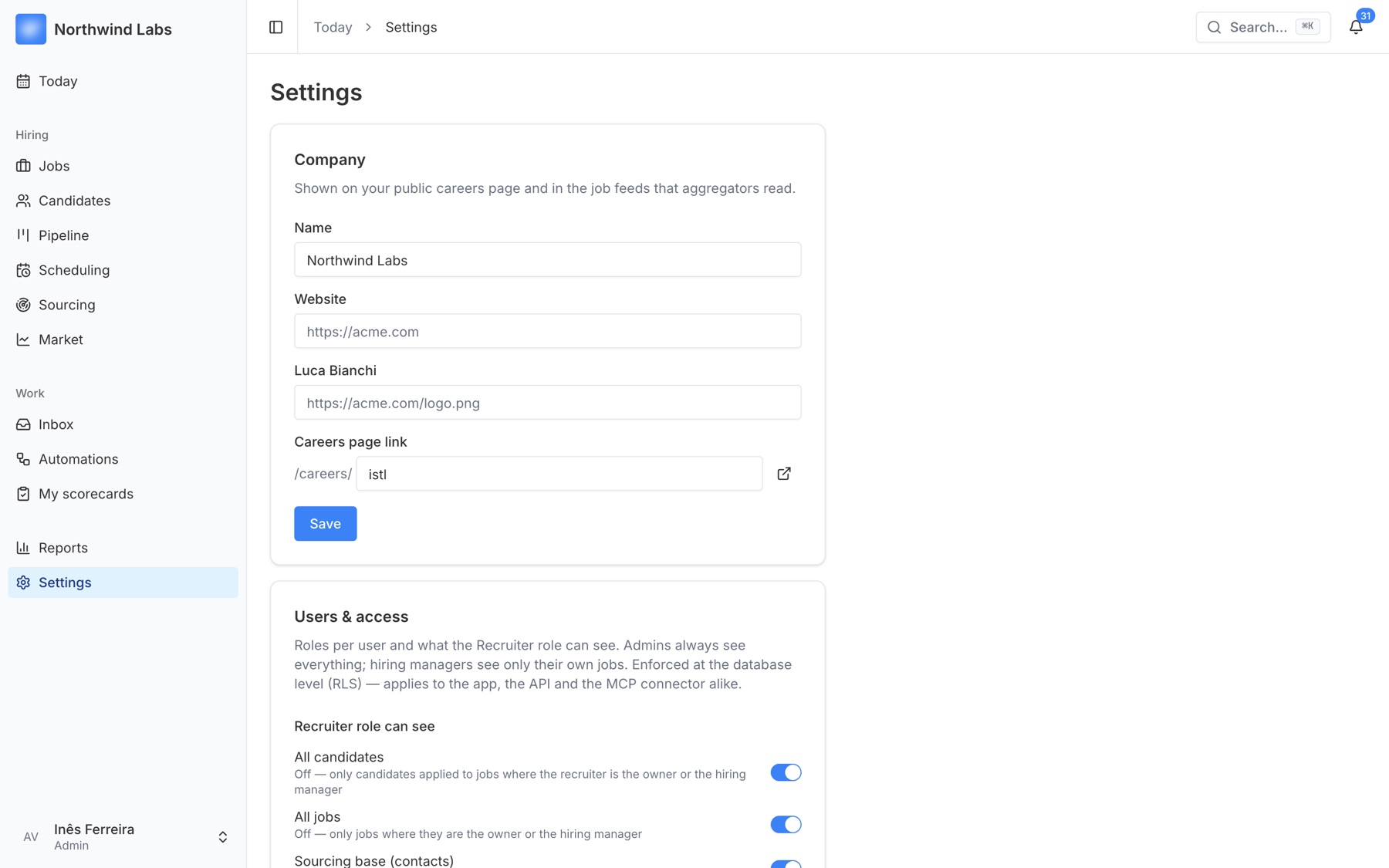
“Out of a hundred AI suggestions, how often did a person disagree?” Settings shows that number for every user. A healthy override rate is your proof that oversight is real, and the product is built to keep it that way.

France, Germany, the UK and the EU default each have their own clock. Nothing is deleted until you switch a rule on.
Everything you hold about a person, in one file, when they ask.
Deleting a person removes their data everywhere, but keeps an anonymous marker so they are never contacted again.
Admin, recruiter, hiring manager. The same rules apply in the app, the API and the browser assistant.
Who you are, where you found them, how to opt out. Included automatically, as GDPR requires.
Nothing hidden behind a LinkedIn visibility setting is ever collected.
There is no official LinkedIn API for finding or messaging people. Tools that copy your login to a server are the first thing LinkedIn detects. So the browser is yours, the login is yours, and the limits are ours.
A 30-minute session: we set up the role, run a first search, and turn one of your interview notes into a finished scorecard.